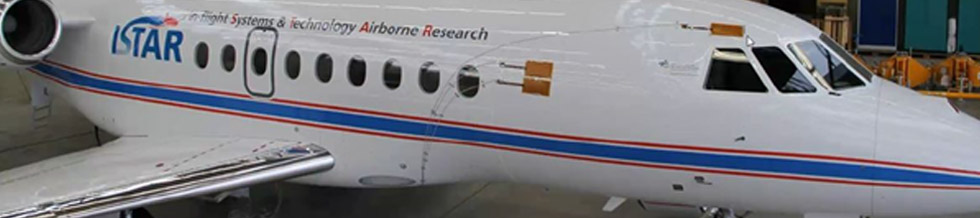
Case Study: Flow measurement on aircraft surfaces
Flex MEMS – Flexible MEMS sensor pad for flow and acoustic measurements on aircraft structures.
Initial situation
Turbulent boundary layers on aircraft outer skins excite the structure and are a major driver of cabin noise, structural vibrations, and limitations regarding lightweight, noise-optimized cabin and fuselage concepts.
The German Aerospace Center (DLR) conducts research into, among other things, aerodynamic flow phenomena and their effects on aircraft structures. It possesses extensive experience in measuring turbulent boundary layers—both in flight tests and in wind tunnels.
The measurement technology used in previous research projects (typically large individual sensors or rigid microphone arrays) is reaching its limits: spatial resolution is too coarse, installation is complex and prone to failure, and the arrays are stationary within the wind tunnel and lack positioning flexibility. Furthermore, there are no means of taking measurements directly on the actual aircraft skin.
The result: There is a lack of high-resolution, realistic data on actual boundary-layer excitation—both in flight tests and in wind tunnels.
Project objective
The FlexMEMS collaborative project aimed to develop a novel sensor pad that:
- is extremely thin and mechanically flexible
- enables a high integration density of MEMS microphones (up to 100 sensors per pad)
- allows for minimally intrusive measurements directly on the aircraft's outer skin ("acoustic patch")
- is modularly scalable for flight and wind tunnel applications.
By using multiple pads in parallel, the accuracy of sound source localization and quantification in the wind tunnel is intended to be improved by a factor of 10.
Collaborative Project and Funding
The FlexMEMS project was funded under the German aviation research program "LuFo V, 3rd Call," which supports industry and research in the development of innovative and safe aviation technologies. The LuFo V aviation research program is funded by the Federal Ministry for Economic Affairs and Climate Action (BMWK).

Project partners were:
- DLR Institute of Aerodynamics and Flow Technology: experimental methods for flow-optimized design, sensor layout design, integration and testing under flow conditions;
- gbm mbH: high-level software, drivers, OS interfacing, data management;
- and D.SignT: system architecture, hardware development, firmware, data transfer, synchronization.
Customer Testimonials

FlexMEMS enables us to deploy a high-resolution microphone array at all critical locations on the aircraft's outer skin. The large number of small, densely packed sensors allows—for the first time—high-resolution capture of the pressure fluctuations of physical interest within the boundary layer, without significantly disturbing the airflow. Close collaboration with D.SignT and gbm made it possible to advance this complex system to the stage of a functional research prototype for wind tunnel and flight tests.


The data rates and synchronization requirements of the FlexMEMS project are demanding. Based on hardware developed by D.SignT and through excellent technical collaboration, we were able to build a scalable software platform that allows multiple sensor pads to be operated in parallel and enables the reliable acquisition and analysis of data.

Technical implementation within the collaborative project
Role of D.SignT
D.SignT was responsible for developing the entire data acquisition and transmission electronics—including system architecture, hardware design, firmware, and the real-time operating system.
The flexible microphone panel was physically separated from the data acquisition electronics (MEMS-DSP) to enable aerodynamic integration. Up to 32 MEMS microphones can be connected per sub-processor; the system is designed to support up to 100 sensors per pad.
100Base-T Ethernet with Power over Ethernet is used for data transmission, power supply, and synchronization. A MEMS concentrator aggregates multiple modules, handles clock generation, and enables scalable array structures.
Role of gbm
gbm was responsible for the end-to-end software architecture of the FlexMEMS system—spanning everything from the sub-processor and concentrator to the control computer. The goal was to create a scalable, real-time-capable platform that reliably meets stringent requirements regarding data rates and synchronization.
Working in close coordination with D.SignT, gbm optimized data throughput, synchronization, and system stability. The software developed enables the configuration of all modules, the secure recording of high data rates, and the live visualization of measurement data—making the overall system suitable for practical use in both wind tunnel and flight test environments.
Role of the DLR
The DLR contributed its scientific expertise in measuring turbulent boundary layers during wind tunnel and flight tests. It defined the metrological and aerodynamic requirements, designed the sensor concept, and integrated the system into realistic test setups.
Furthermore, the DLR developed specialized analysis methods to precisely analyze the pressure fluctuations acting on the aircraft's outer skin. Through experimental validation under realistic flow conditions, the DLR ensured that FlexMEMS is scientifically robust and suitable for demanding flight tests.
Results & Innovation Content
The developed measurement system demonstrates that the flexible MEMS sensor pad:
- captures high-precision pressure fluctuations in the turbulent boundary layer
- performs phase-locked, synchronous measurements across multiple channels
- allows for integration with minimal aerodynamic impact
- enables detailed analysis of vortex systems in the wind tunnel
Validation
Extensive environmental and functional tests were conducted during the project. The system successfully passed cold-temperature tests down to –60°C, EMC tests (both in the laboratory and on the aircraft), and wind tunnel trials at flow velocities up to 43 m/s, with no sensor failures.
Innovation
- novel, flexible sensor pad acting as an "acoustic patch" with a high channel count
- flexible positioning within the wind tunnel, independent of fixed microphone arrays
- significant reduction in installation effort for flight tests
- foundation for quieter, lighter aircraft cabins and optimized structural and propulsion concepts
Conclusion and Outlook
FlexMEMS clearly demonstrates how modern MEMS sensor technology, flexible PCB technology, and custom DSP electronics can be combined to create a completely new type of measurement system. The sensor pad is quick to install, delivers very high spatial and temporal resolution, and remains stable during operation even under demanding conditions such as cold temperatures, high flow velocities, or electromagnetic interference (EMI).
Close, constructive collaboration between the three partners was crucial to this success: DLR contributed the aerodynamic and measurement requirements as well as the testing environment. Based on this, D.SignT designed a robust, high-performance hardware architecture, while gbm developed the software to aggregate, process, and store the measurement data.
This foundation paves the way for future developments, including larger array geometries, modularly scalable solutions featuring multiple pads, and further wind tunnel and flight tests. Moreover, the technology opens up prospects for industrial applications in acoustics, flow diagnostics, and structural health monitoring—extending well beyond the aerospace sector.
The system's potential is further evidenced by the fact that FlexMEMS was certified for a test flight on an Airbus A320 and successfully tested in that environment.
Are you planning a highly integrated measurement system for flow or acoustic measurements? Talk to us about flexible MEMS arrays and custom measurement technology assemblies.